

TL;DR: You can’t stop people from using AI or put it back in the box. Blocking AI crawlers feels satisfying but just makes you invisible to users who rely on AI recommendations. This post covers the tradeoffs content creators face in an AI world and why embracing AI integrations beats hiding from them.
Over at Talk Python To Me, I added a couple of deep AI integrations. You can read about them here at talkpython.fm/blog/posts/announcing-talk-python-ai-integrations/. A couple of folks in the community asked what I thought about how embracing AI consumption of our content would affect us. Or, how in the light of the tailwind situation, it might even undermine us.
Wait, what happened to Tailwind?
If you’re not familiar with the Tailwind situation, the TLDR is that their usage has gone up 6x over the last year while the revenue has fallen to one-fifth of what it was a year prior. Basically, AI is using and recommending Tailwind like crazy, which counterintuitively has destroyed their web traffic, and hence reduced people seeing and upgrading to their pro offers.
Fear of AI ingestion
I know many content creators (writers, podcasters, and so on), are pretty frustrated with AI. I totally get it. We all work very hard to create content that gets ingested by AI. Then people ask questions of the AI. AI uses our content to answer the question, usually without referencing our work.
This has led a lot of people to think that maybe they should block AI from even reading what they’re doing. Here are some examples:
- Reddit: How can we stop AI to read our website information
- Not On My Watch! 🚫 Block AI From Training On Your Website
I get the frustration and the ick factor. But I fear that blocking AI is going to end up in a similar situation as if you decided to block Google in 1998. For sure, those suckers will not be able to train on your content. But as users rely more and more on AI for recommendations, you will vanish from awareness in much the same way as if you had vanished from Google search results.
You’re welcome to block AI crawlers, and most of them will respect it. But that won’t make AI go away, nor will it make users stop using AI.
If you’re going to be in AI results…
If you’re going to be in AI results anyway, you should want the very best experience for current and potential users.
First, you do want to be recommended. After all, that’s how I sold this to you, right? The new Google. It’s a bit of the Wild West still, but there are tools that you can use to check how you appear in AI results. Here’s an example from ProductRank.ai for Python Podcasts.
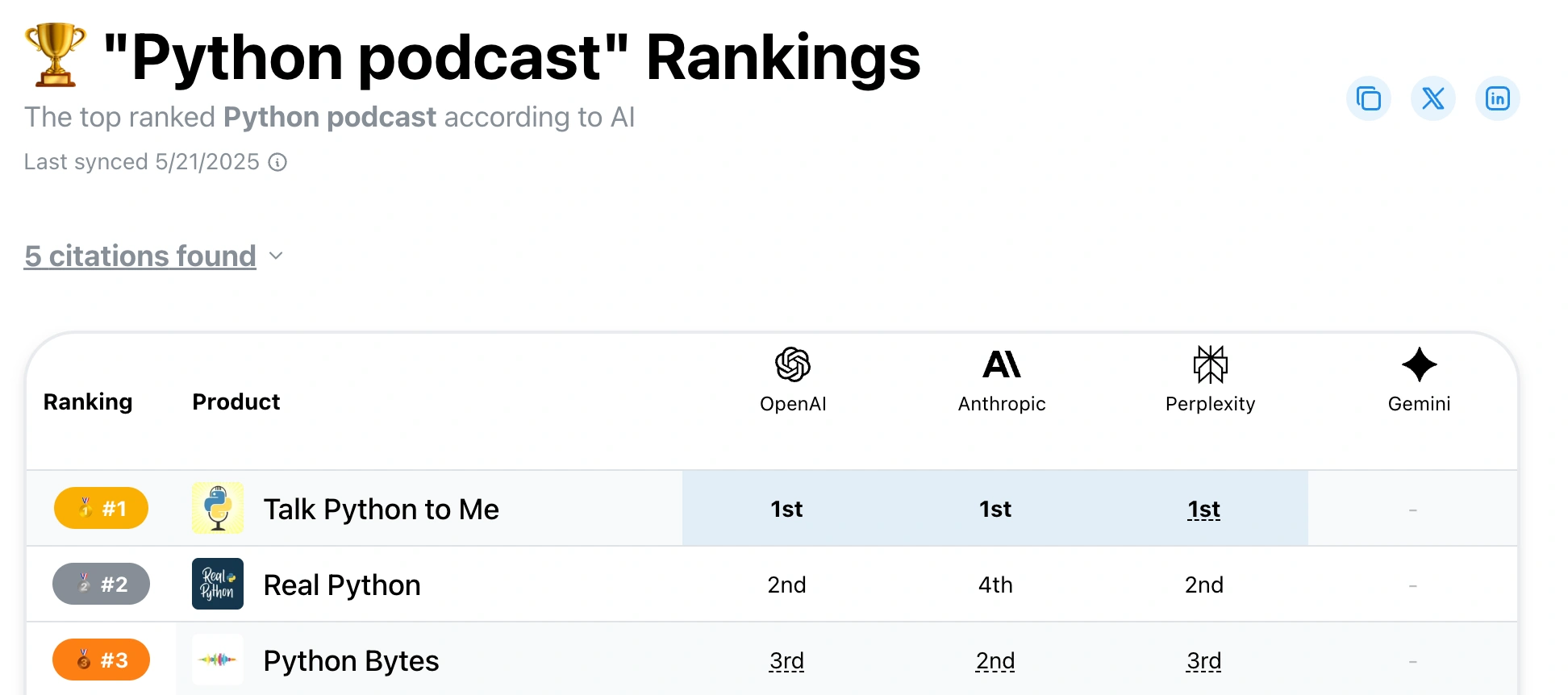
Talk Python to Me is the number one recommended podcast when users ask ChatGPT, Claude, or Perplexity for a Python podcast. And my other podcast, Python Bytes, is number three. Honestly, I’m thrilled at this result. If anyone is talking to these AIs and says, “Hey, I would love a podcast to listen to. Do you have recommendations?” Here you go.
What would the experience be if I got mad at AI and blocked it? I simply would be invisible to all of these users wanting to learn about Python podcasts. Whatever effect AI is going to have on Talk Python in the future, disappearing from its recommendations is not going to make it better.
What will make it better?
How can we improve our situation of, say, decreased traffic or fewer customers? And I’m not even saying that that has actually happened for Talk Python, the podcast. It’s still going strong, just speaking generally.
Obviously, getting recommended more is key, so see above. Offering a better experience to your users when they ask questions about topics your content covers or even specifically about your content in particular.
That is why I added the AI integrations to Talk Python. Not so that AI could undermine us even more, but so that our users would get more value from years and years of content we’ve already created. Counting the transcripts, deep dives, and episode pages, we have well over 7 million words of content at talkpython.fm.
If users want to ask AI about that content, I want AI to give them as good and accurate of a response as possible. Here are some super frustrating experiences that you sometimes get from AI.
- Outdated data: My training only goes back to the summer of 2025, so here are the most recent results according to that.
- Imaginary data: My mistake. You’re absolutely right! President Obama did appear on Talk Python back in 2008! Here’s a link to that interview …
Out of date data, and especially, hallucinated data is why so many people are creeped out by AI and want to use AI less. The AI integrations that I created significantly reduced this by providing real-time information to AI, as well as tools to verify what it thinks exists, actually does, and link back to it.
How it looks with AI integrations
Check out this response from Claude when I asked what the latest 5 episodes of Talk Python To Me are:
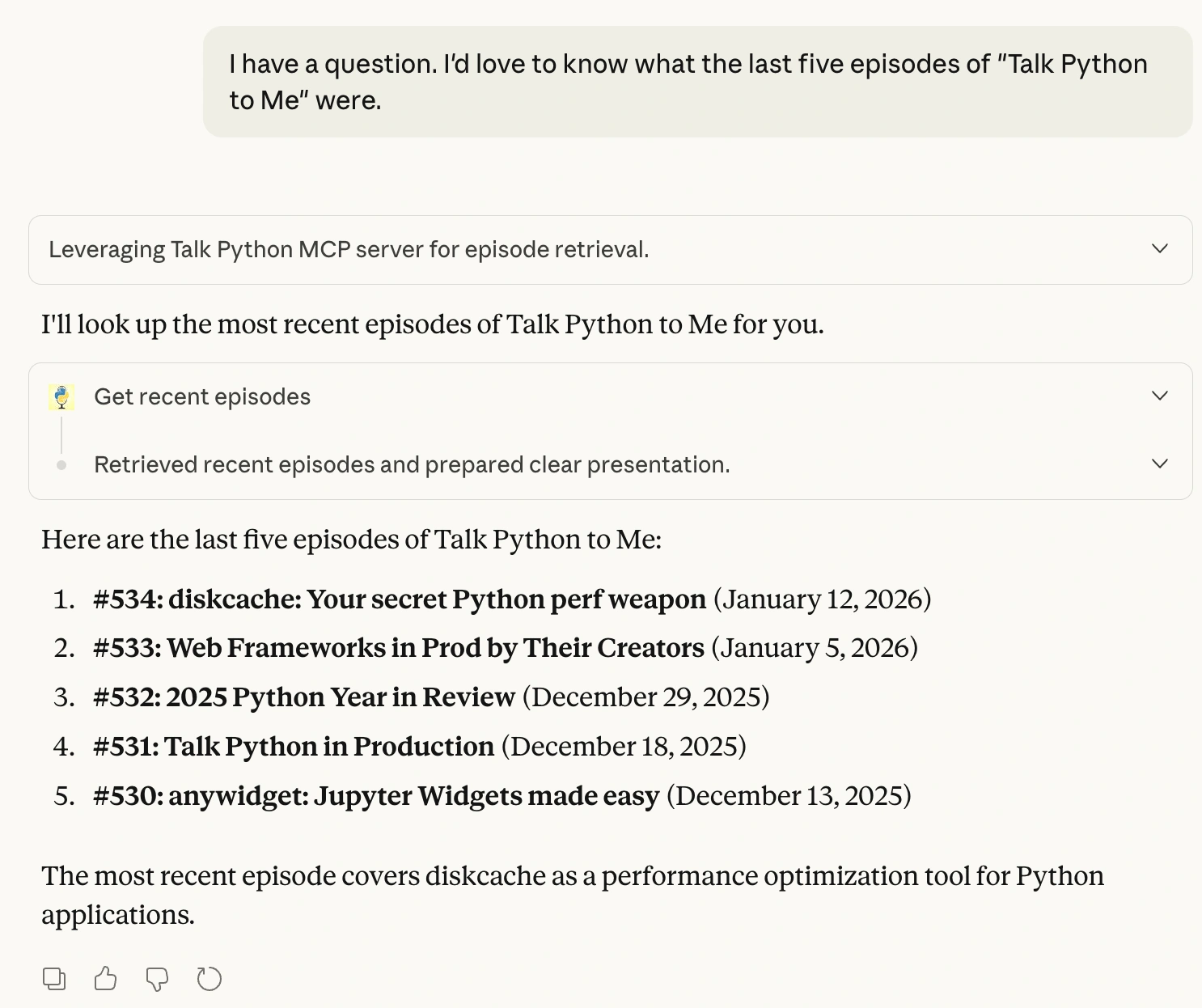
This is real-time information. If I publish a new episode, or heck, even change the title of an older one, and ask this question again in a separate chat conversation 10 seconds later I will get up-to-date information.
There are many tools that the AIs can use that we’ve provided so that our content is more accurate, more up-to-date, and more useful. This can only mean that AI will recommend our content more and link back to it more accurately.
Here is another example which I posed in a totally fresh chat: Can you recommend a Python course on agentic AI and cursor?
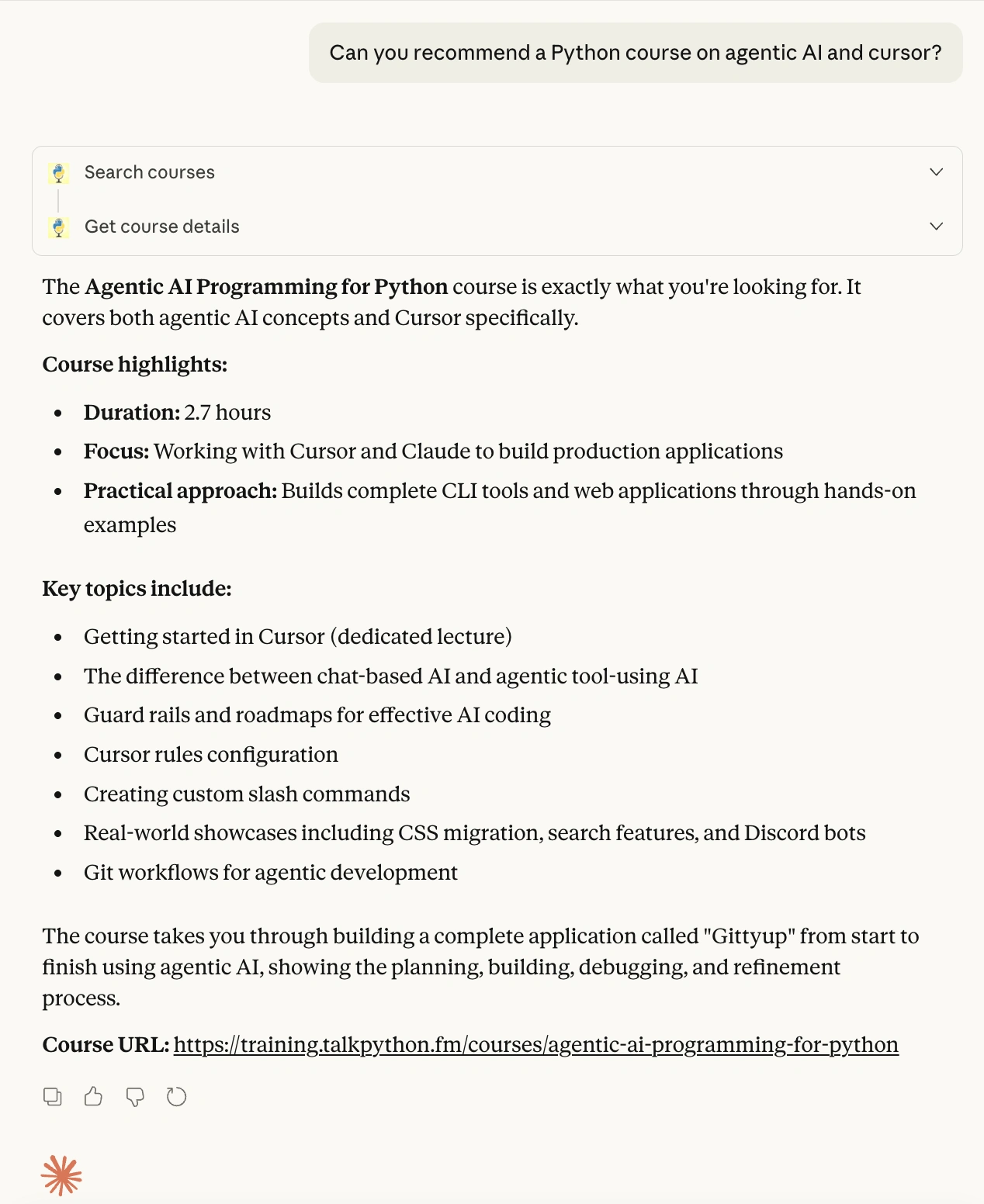
Notice, I did not ask Claude to recommend a Talk Python course on Agentic AI. I simply asked it for any Python-based Agentic AI and Cursor course. Now, I have installed the Talk Python MCP server, so that probably influenced Claude, but still this is very powerful.
Blocking AI crawlers might be a bad idea
This is exactly why I think blocking AI crawlers is probably a bad idea. Yes, it’ll make you feel great if you’re pissed at AI: “You’ll show them!" But it likely will not further your cause in sharing ideas, gaining awareness, and much more.
So for all of you who have asked me why I’m willing to make Talk Python more accessible to AI in the immediate shadow of Tailwind and Stack Overflow suffering greatly from AI, this is why.
Thanks for checking out my content, whether you got here through an RSS reader, web search, or maybe even an AI recommendation. ;)
Cheers, Michael.