
TL;DR; Chameleon-robyn is a new Python package I created that brings Chameleon template support to the Robyn web framework. If you prefer Chameleon’s structured, HTML-first approach over Jinja and want to try Robyn’s Rust-powered performance, this package bridges the two.
People who have known me for a while know that I’m very much not a fan of the Jinja templating language. Neither am I a fan of the Django templating language, since it’s very similar. I dislike the fact that you’re mostly programming with interlaced HTML rather than having mostly HTML that is very restricted in what it allows in terms of coding. While nowhere near perfect, I prefer Chameleon because it requires you to write well-structured code. Sadly, I think Jinja won exactly because it allows you to write whatever Python code in your HTML you want. For most frameworks, Jinja is the only templating language they support.
Why migrate Chameleon templates to a new framework?
I’d love to try out some new frameworks, but I have so much existing Chameleon code that any sort of migration will never include converting to Jinja, if I have a say in it. Not because of my dislike for it, but because it’s incredibly error prone, and it would mean changing my entire web design, not just my code.
Here’s the code breakdown for just Talk Python Training.

That design category is 14,650 lines of HTML and 11,104 lines of CSS! If I can get Chameleon running on a framework, it will 100% reuse every line of that to perfection. If I cannot, I’m rewriting them all. No thanks.
How does Robyn use Rust to speed up Python web apps?
I’ve been thinking a lot about what if our web frameworks actually ran in Rust? Right now I’m running Quart (async Flask) on top of Granian. So Rust is the base of my web server and processing. But there is a lot of infrastructure provided by Flask and Werkzueg leading up to my code actually running that is all based on Python.
Would it be a lot faster? Maybe. My exploring this idea was inspired by TurboAPI. TurboAPI did exactly this as I was thinking about, but with Zig and for FastAPI. While I am not recommending people leave FastAPI, their headline “FastAPI-compatible. Zig HTTP core. 22x faster,” does catch one’s attention.
Eventually I found my way to Robyn. Robyn merges Python’s async capabilities with a Rust runtime for reliable, scalable web solutions. Here are a few key highlights:
- Runtime: Rust-based request handling for high throughput
- API style: Flask-like Python API, making migration straightforward
- Async: Built-in async support out of the box
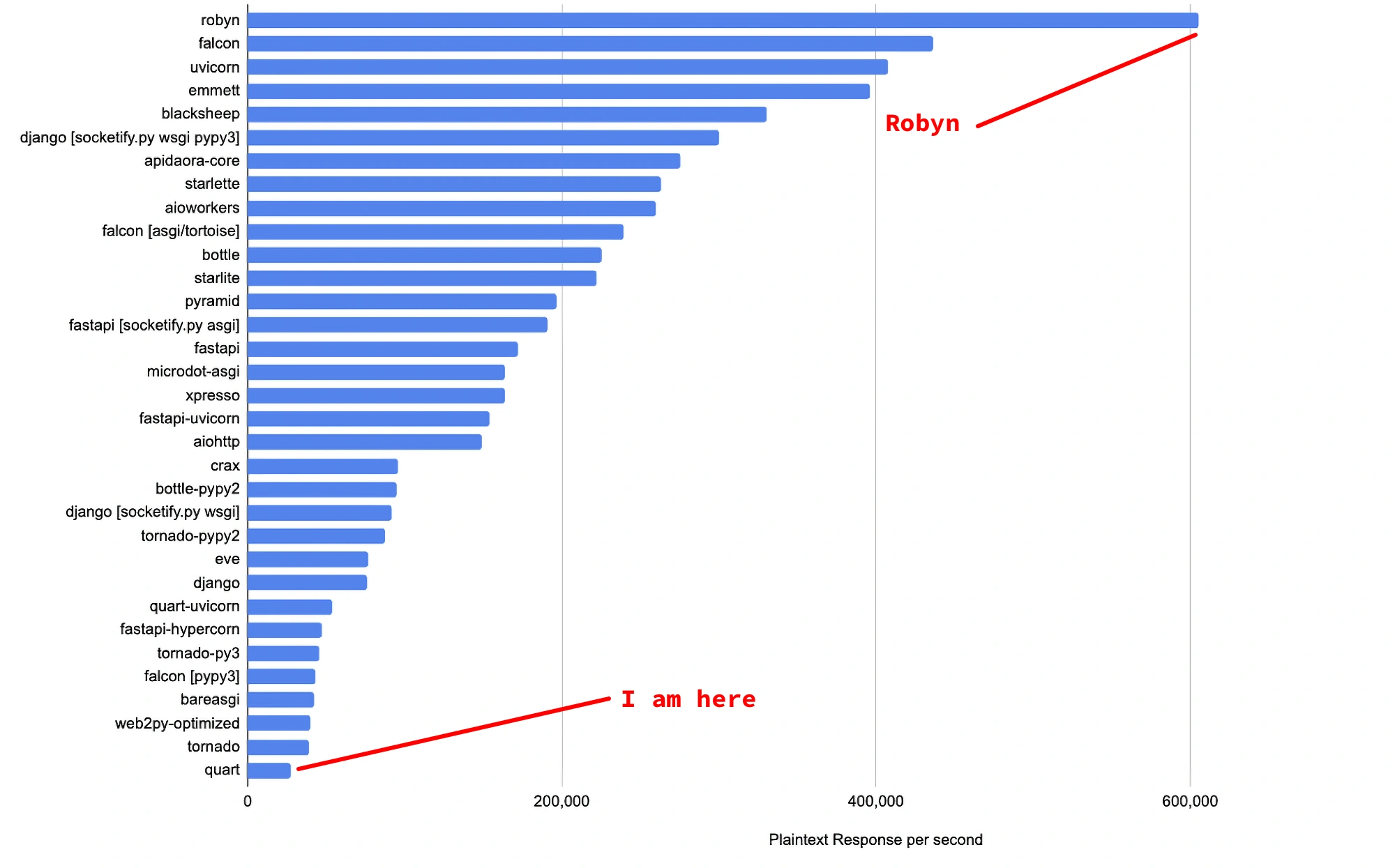
There’s this quite interesting performance graph from Robyn’s benchmarks. Of course, take it with all the caveats that benchmarks come with.
How to use Chameleon templates with Robyn
I want to try this framework on real projects that I’m running in production to see how they size up. However, given all of my web UI is written in Chameleon, there’s absolutely no way I’m converting to Jinja. I can hear everyone now, “So just use it for something simple and new, Michael.” For me that defeats the point. Thus, my obsession with getting Chameleon to work.
I created the integration for Chameleon for Flask with my chameleon-flask package. Could I do the same thing for Robyn?
It turns out that I can! Without further ado, introducing chameleon-robyn:
It’s super early days and I’m just starting to use this package for my prototype. I’m sure as I put it into production in a real app, I’ll see if it’s feature complete or not.
For now, it’s out there on GitHub and on PyPI. If Chameleon + Robyn sounds like an interesting combo to you as well, give this a try. PRs are welcome.