
TL;DR; After migrating three production Python web apps from MongoEngine to the Raw+DC database pattern, I measured nearly 2x the requests per second, 18% less memory, and gained native async support. Raw+DC delivered real-world performance gains, not just synthetic benchmarks.
About a month ago, I wrote about a new design pattern I’m seeing gain traction in the software space: Raw+DC: The ORM pattern of 2026. This article generated a lot of interest and a lot of debate. The short version: instead of using an ORM or ODM, you write raw database queries paired with Python dataclasses for type safety. This gives AI coding assistants a much larger training base to work from, reduces dependency risk, and delivers comparable or better performance.
Putting Raw+DC into practice
Now that some time has passed and I’ve thought about it more, I’ve had a chance to migrate three of my most important web apps to Raw+DC: Talk Python the podcast, Talk Python Courses, and Python Bytes.
So how did it go? From a pure functionality perspective, it went great. There were maybe one to three problems per web app. This might not sound great, and I didn’t love it, but given this is thousands and thousands of lines of code per app, that’s a small percentage of issues, given how many things went right.
More importantly, I was able to remove a dependency on two faltering database libraries. Mongoengine, the one that I’m going to pull numbers from for Talk Python Training below, has not had a meaningful release in years. It was one of the two core blockers that prevented me from using async programming patterns on the website entirely.
How much faster is Raw+DC than MongoEngine?
I said I imagined that we would save in memory and CPU costs, but did it actually pan out in a practical application? After all, we saw that Robyn, the web framework, is 25 times faster than Flask. However, in practice, it was almost a dead even heat.
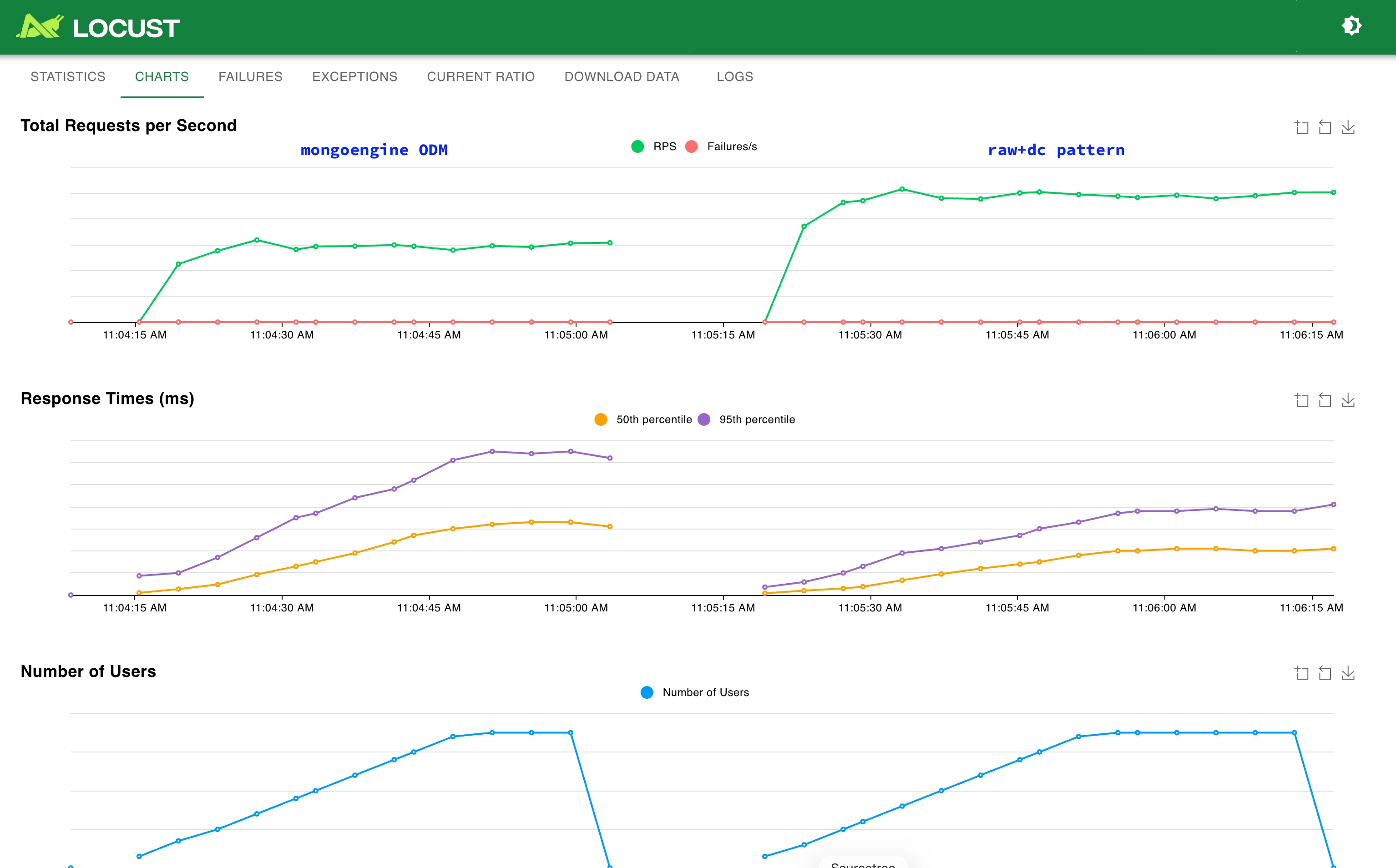
I’m thrilled to report that yes, the web app is much faster using Raw+DC.
Below is an apples-to-apples comparison for Talk Python Training using MongoEngine and the Raw+DC pattern.
| Metric | MongoEngine (ODM) | Raw+DC | Improvement |
|---|---|---|---|
| Requests/sec | baseline | ~1.75x | 1.75x faster |
| Response time | baseline | ~50% less | ~50% faster |
| Memory usage | baseline | 200 MB less | 18% less |
The memory story is really great as well. After letting the web app run for over 24 hours for each mode, we saw a 200 MB memory usage decrease using Raw+DC.
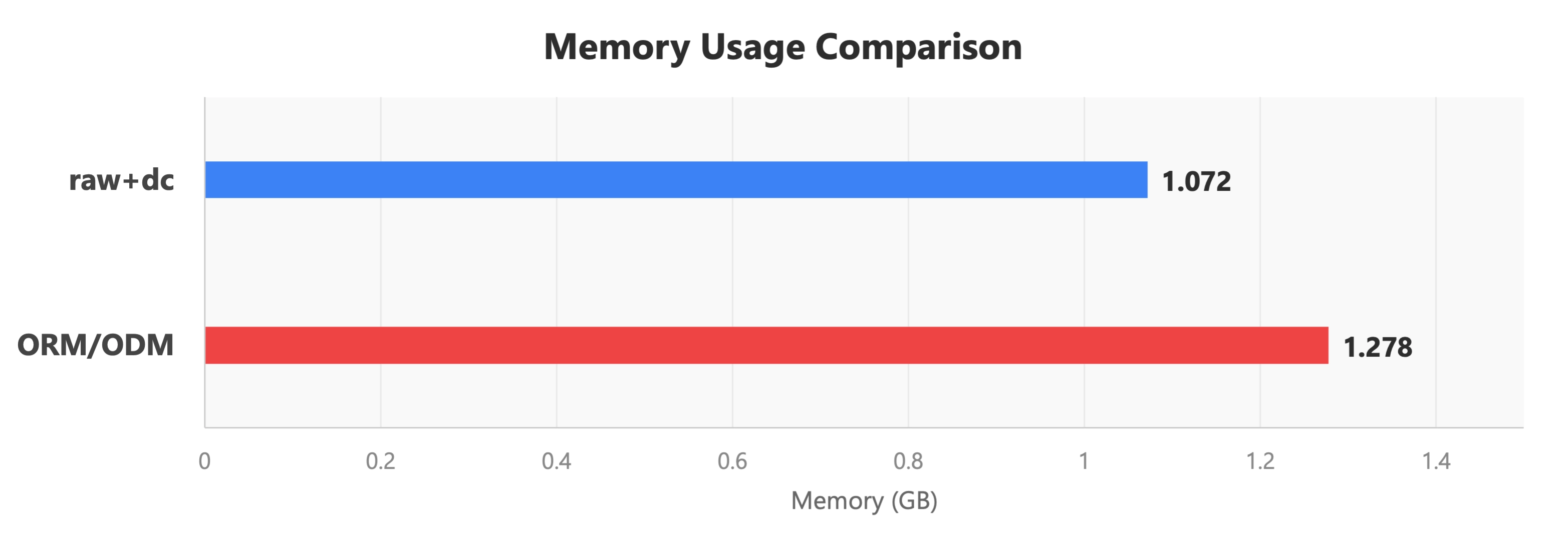
That amount of memory might still look high to you. This Raw+DC transformation actually facilitates future work that will cut it in half again, down to about 500 MB for the full app, up and running in production at equilibrium.
Is Raw+DC worth migrating to?
To me, this seems 100% worth it. I’ve gained four important things with Raw+DC.
- 1.75x the requests per second on the exact same hardware and codebase (sans data layer swap)
- 18% less memory usage with much more savings on the horizon
- New data layer natively supports async/await
- Removal of problematic, core data access library
All of these benefits and none of that even touches on whether or not this new programming model is better for AI (it is).